
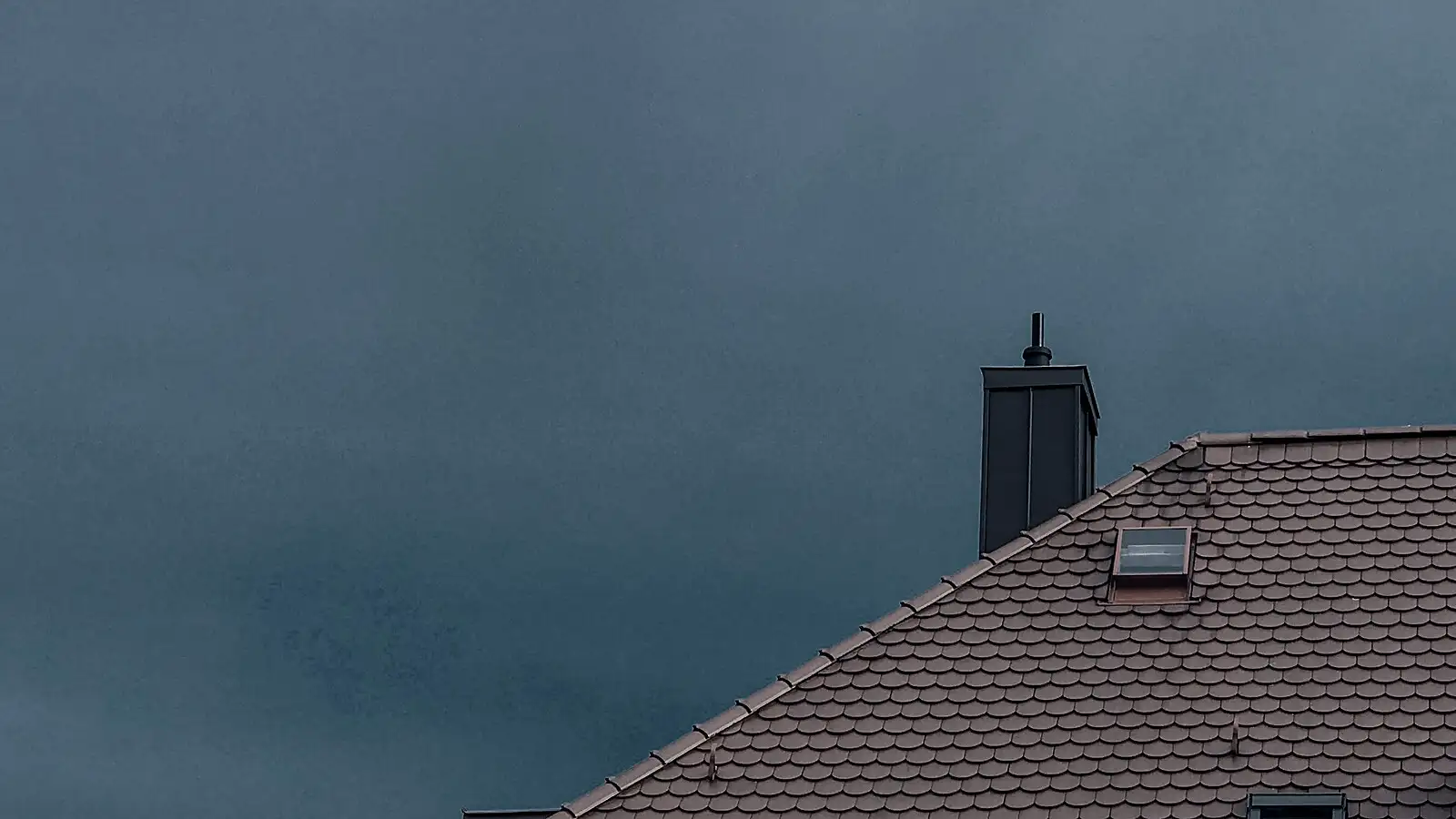
Roof replacement in Jackson
Jackson is the largest municipality in Ocean County at 99.17 square miles, part of it inside the Pinelands National Reserve, sitting well back from the coast in the Toms River watershed with Interstate 195 across the northern end. Building here went from roughly 100 homes a year in the late 1950s to about 750 a year through the 1960s, then past a thousand units a year in the 1970s and 1980s. That wave is what is reaching the end of its second roof now.
What ends a roof in Jackson
Canopy over the roof, litter in the valleys
Pine needles do not blow off a roof the way leaves do. They mat in the valleys and along the gutter line, hold water against the shingle and keep the seam under them wet through the winter. On a large Jackson lot with mature trees on three sides, the valleys are the part of the roof that ages first and the part nobody can see from the driveway.
Shade keeps the north slope damp
The slopes that never see direct sun stay wet for hours after the ones that do have dried. In a humid pine woodland that is enough for algae and moss to establish, and moss is the more serious of the two because it lifts the edge of the course it grows under. On many Jackson roofs the north slope fails years before the south.
A thousand houses a year, all aging together
A township that put up more than a thousand units a year for two decades gets a very large group of roofs arriving at the same point in life at the same time. The 1970s and 1980s stock has been recovered once already in most cases, which is what makes the two-layer limit the practical question rather than an abstract one.
Custom geometry costs more than square footage
The larger-lot houses built here from the 1980s onward tend to carry hips, dormers, bay projections and multiple intersecting ridges. Every one of those is a flashing detail and a place for the roof to leak long before the field shingles wear out. The number of planes on a roof drives the work more than the number of squares does.
When patching stops being the answer
- The covering is at or past twenty years — where Ocean County carriers start looking.
- Two applications are already on the deck, so no third is allowed and the next roof is a tear-off.
- Granules in the gutters and bare asphalt showing on the water-facing slope.
- Tabs creased or unsealed across a whole run rather than in one spot.
- You have paid for the same slope twice.
How a Jackson roof comes apart
Specifying a Jackson roof means specifying the valleys and the ventilation, not just the shingle. Closed-cut versus open metal valley matters more here than on an open shore lot, and intake at the eave has to balance the ridge vent or the attic under all that shade holds moisture through the winter.
What a replacement involves
What varies house to house is stage two, once the deck is finally visible. The full walk-through is on the roof replacement page; wind classification and fastening are on the asphalt shingle replacement page.
Services available in Jackson
- Roof ReplacementDown to the deck and back up, on shore roofs that are past their last patch.
- Storm Damage Roof ReplacementNor'easter uplift, lost courses and the claim that follows.
- Asphalt Shingle ReplacementWind classes, fastening and coastal spec for a shore roof.
- Roof Inspection ReportSlope-by-slope findings in writing, dated, for a carrier or a buyer.
Areas covered in Jackson
Contractors cover Jackson and the surrounding area, including Cassville, Whitesville, Bennetts Mills, Legler, Prospertown, Van Hiseville, Jackson Mills and Holmansville.
ZIP codes: 08527.
Frequently Asked Questions
- There is moss on one side. Does that mean replacement?
- It means an inspection with somebody actually on the roof. Moss holds water and lifts the edge of the shingle it grows beneath, so what matters is whether the courses under it are still sealed and whether granule cover is intact. Moss on a roof at twelve years is a maintenance item. The same moss on a roof at twenty-two is usually the last chapter.
- Is Jackson far enough inland to skip high-wind detailing?
- That is not a call to make from a map. New Jersey stopped publishing a statewide wind table; the design value comes back per site, and a large township like this one is not uniform across 99 square miles. Detailing to a lighter standard than the address calls for is exactly the sort of thing that voids the manufacturer's wind coverage.
- How do I tell a worn roof from a dirty one?
- Streaking is biological and mostly cosmetic. What tells you the roof is finished is granule loss — bare asphalt showing through, granules accumulating in the gutters, edges that have gone brittle and curl instead of lying flat. Those are visible from a ladder at the eave and are worth checking before deciding the problem is only appearance.
- Do I have to take the trees down to keep a roof alive?
- No, but overhanging limbs should come back off the roof plane. Branches that touch abrade granules every time the wind moves them, and a canopy directly above keeps the surface shaded and damp. Trimming back to clear the roof and keeping the valleys clear of needle mat does most of the work. Removing mature pines is a landscaping decision, not a roofing one.
- Who answers, and when can I call about a Jackson roof?
- The line is staffed Mon–Fri 8:30 AM – 7:00 PM · Sat 9:00 AM – 4:00 PM ET. It reaches Roof Replacement Toms River, which is a referral service rather than a roofing company: the call is passed to an independent contractor working in Jackson and the surrounding Ocean County area. Scope, timing and what an inspection involves are discussed on that call. Verifying that whoever you hire carries the license and insurance the work requires remains yours to do.